
Internet Real Estate Leads: Paid vs. Automated for Solo Agents
You are running a one-person operation. Every lead source has to earn its place in your week, not just your spreadsheet. The real question about internet real estate leads is not which type is better in theory. It is which one you can actually convert given your cash flow, your response capacity, and how much…
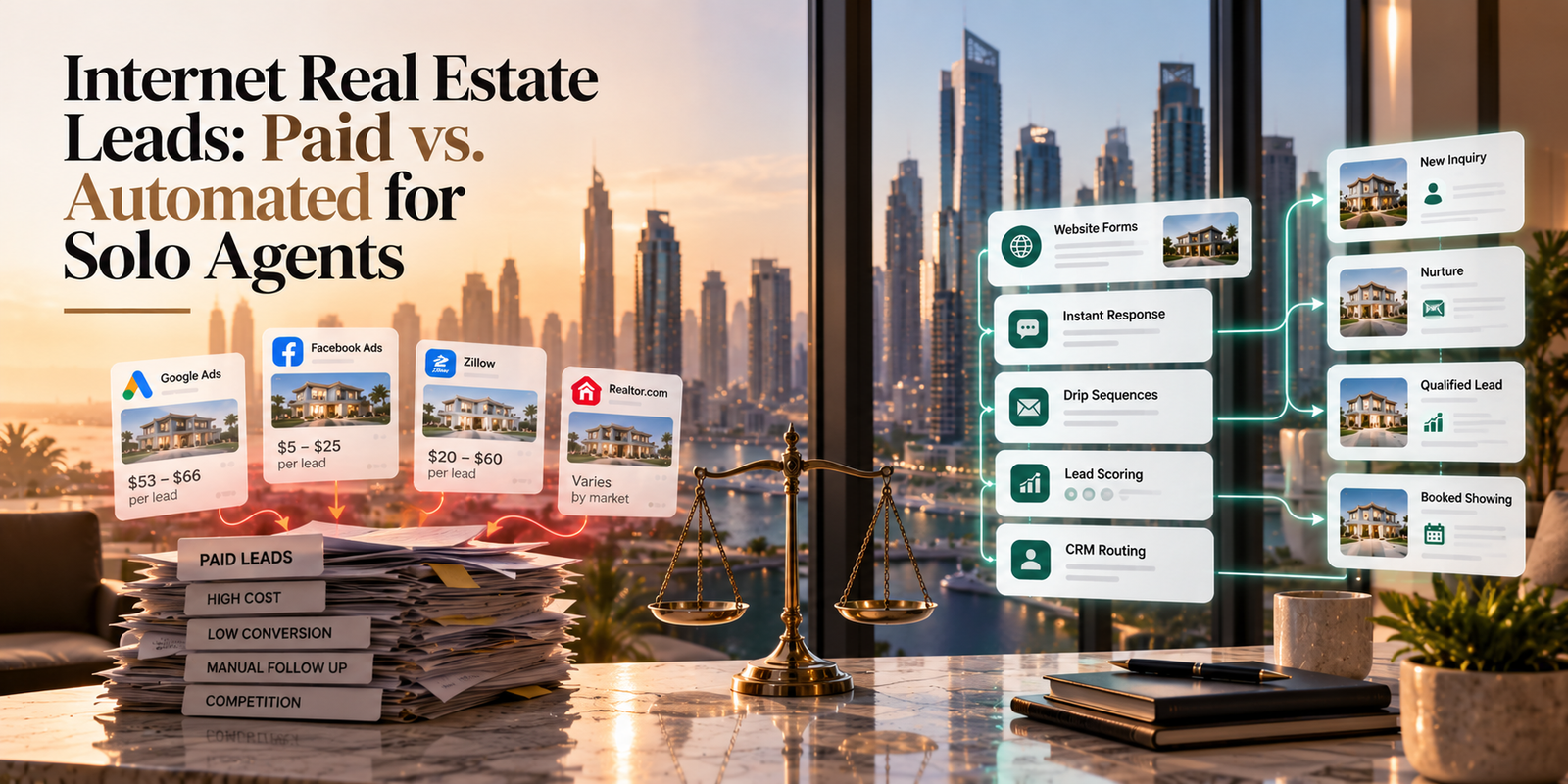
You are running a one-person operation. Every lead source has to earn its place in your week, not just your spreadsheet.
The real question about internet real estate leads is not which type is better in theory. It is which one you can actually convert given your cash flow, your response capacity, and how much manual work you can stomach.
Paid leads buy speed. Automated systems buy leverage. Neither one is free, and neither one works without the right conditions behind it.
What Each Approach Actually Means
Paid internet leads come from channels where you exchange money for attention: Google Ads, Facebook and Instagram ads, Zillow Premier Agent, Realtor.com. These channels can start pushing contacts into your pipeline within days.
The catch is they keep costing money every month, and internet leads across all paid channels commonly convert in the 1% to 4% range.
Automated internet leads are not a traffic source. They are a handling system.
You still need a source of inbound interest, but once a contact enters your IDX site or fills out a form, automation takes over: instant response, lead scoring, drip sequences, CRM routing. The agent stops being the first responder and starts being the closer.
The Conversion Problem Paid Leads Create
The average agent responds to a new internet lead in 917 minutes. That is not a typo. Responding within an hour makes a meaningful difference to qualification rates, and most solo agents cannot hit that mark consistently because they are already handling showings, contracts, and client calls.
Paid leads are designed for speed. If you cannot respond fast, you are paying for contacts that go cold before you even dial. The lead cost on paper looks manageable until you account for how many never get worked at all.
Google Ads real estate leads run roughly $53 to $66 per lead depending on market. Facebook can be cheaper, $5 to $25, but intent varies widely.
Zillow Premier Agent slots in around $20 to $60. None of those numbers matter if your conversion rate cannot support the spend after commissions and the time you spend chasing contacts who already called someone else.
Where Automated Systems Win for Solo Agents
Automation does not replace lead generation. It makes each contact more valuable by removing the follow-up burden from your plate. A lead that enters a CRM and gets an immediate text response, a drip sequence, and behavioral scoring works differently than one that sits in your inbox until you remember to call.
The operational advantage is consistency. Paid traffic gives you spikes. When the budget pauses, the flow stops.
An automated system attached to steady inbound traffic, IDX visits, saved searches, valuation requests, keeps working without you watching it. That is the difference between buying pipeline activity and building a pipeline asset.
For a solo agent who is already overloaded, more lead volume is not the answer. More conversion from existing volume is. Automation addresses that problem directly.
Intent Quality Changes the Math
Not all internet leads carry the same purchase intent, and that difference reshapes the cost comparison significantly. A consumer who typed a specific neighborhood and price range into Google is actively looking for help right now.
A consumer who clicked a Facebook ad while scrolling through their feed may be six months away from a decision, or never serious at all.
Search-based leads cost more per click but tend to convert at higher rates because the intent is already there. Social leads are cheaper to generate but require more nurture time before they are appointment-ready, which means they demand more from your automation layer or more from your personal follow-up.
For a solo agent with limited hours, paying more per lead for stronger intent is often the better trade than paying less for a contact you have to warm up for months.
Automated systems earn their highest ROI when they sit behind intent-rich traffic sources: IDX searches with saved listings, repeated site visits, home valuation requests. Those behaviors signal real interest. A drip sequence sent to a cold social click is harder to convert than one sent to someone who viewed fifteen listings in the past week.
How to Evaluate Which One Fits Your Situation
Start with your response capacity. If you can realistically respond to a new inquiry within minutes during business hours, paid leads are worth considering. If your schedule makes that impossible most days, you will bleed ad spend without getting the conversion rates that justify it.
Then look at your cash flow. Paid channels require sustained monthly spend before you see closings.
The pipeline lag in real estate means you might spend three to four months before a paid lead closes. If your cash position cannot absorb that runway, starting with automation and organic or lower-cost traffic makes more financial sense.
A Practical Comparison
| Factor | Paid Leads | Automated Internet Leads |
|---|---|---|
| Speed to launch | Fast | Moderate setup time |
| Ongoing cash requirement | High | Lower per contact |
| Follow-up burden | High | Low |
| Consistency over time | Spend-dependent | System-dependent |
| Best conversion condition | Fast, disciplined follow-up | Good traffic source plus CRM |
| Best for | Agents who need immediate volume | Agents who need efficiency |
When Paid Leads Are the Right Call
Paid leads make sense when you have the cash flow to sustain monthly spend for several months without expecting early ROI. They work when you have a fast-response process, a defined niche or geography that sharpens targeting, and the discipline to track cost per lead, cost per appointment, and cost per closing.
They are a poor fit when your schedule prevents fast follow-up, when your market is broad and competitive enough to drive up cost per lead, or when you have not yet built a CRM process that can handle volume without leaking contacts.
When Automated Systems Are the Right Call
Automated internet lead systems make sense when you are already stretched thin and need workflow support more than raw volume. They work when you have an IDX presence or website that can be improved to capture more of the traffic you are already getting.
They make the most sense when you want each inquiry to be worked properly, not just touched once and forgotten.
The practical setup that works for most solo agents is not choosing one or the other. Start with one paid channel and one automation layer, measure what each costs in money and time, and expand only what is actually working.
Blending paid traffic with automated nurture is how solo agents close more without hiring someone to run the pipeline for them.
| Factor | Paid Leads | Automated Internet Leads |
|---|---|---|
| Speed to launch | Fast | Moderate setup time |
| Ongoing cash requirement | High | Lower per contact |
| Follow-up burden | High | Low |
| Consistency over time | Spend-dependent | System-dependent |
| Best conversion condition | Fast, disciplined follow-up | Good traffic source plus CRM |
| Best for | Agents who need immediate volume | Agents who need efficiency |
Keep reading: Real Estate Lead Generating: DIY Hustle vs. Automated Systems - Which Actually Pencils Out? · A New Video Ad Every Week, No Editor on Payroll
Frequently Asked Questions
What is a realistic conversion rate for internet real estate leads?
Most paid internet lead channels convert in the 1% to 4% range. That number depends heavily on how fast and consistently leads are followed up, and on how well the lead source matches buyer or seller intent.
How much do paid real estate leads cost per lead?
Costs vary by channel. Google Ads real estate leads commonly run $53 to $66 per lead. Facebook leads can be $5 to $25 but vary more in quality. Zillow Premier Agent typically falls in the $20 to $60 range depending on market.
Can a solo agent realistically run both paid leads and automation at the same time?
Yes, and for most solo agents it is the strongest setup. Use a paid channel to generate immediate pipeline activity, then use automation and CRM to ensure every contact is followed up properly. Start small with one of each, measure results, and expand what works.
Why do paid leads underperform for solo agents specifically?
The main reason is response time. Paid leads expect fast contact, often within minutes. Solo agents handling showings, contracts, and client calls rarely hit that window consistently. When response is slow, leads go cold and the cost per conversion rises sharply.
What does an automated internet lead system actually require to work?
An automated system needs a source of inbound traffic, an IDX site, a form, or a valuation tool, plus a CRM that can handle instant response, drip sequences, and lead scoring. The automation handles the follow-up; the agent still needs a way to generate the initial inquiry.
How 1TeamLabs Can Solve It
1TeamLabs’ Sales Automation AI Worker handles the follow-up layer that most solo agents cannot staff: instant response to new inquiries, structured nurture sequences, and pipeline tracking, without adding a human coordinator. It owns that function end-to-end so the agent stays focused on appointments and closings.
See How 1TeamLabs Handles the Follow-Up You Cannot
If the analysis here matched your situation, 1TeamLabs can show you exactly how a Sales Automation AI Worker runs your lead follow-up end-to-end. Book a short call and walk through what that looks like for your specific pipeline.
Book a Demo
About the Author
Written by the 1TeamLabs team, builders of AI Workers that run full business functions for solopreneurs and small teams.
Real Estate Lead Generating: DIY Hustle vs. Automated Systems - Which Actually Pencils Out?
Here is the real question: do you have more time or more money? That one answer decides almost everything about which real estate lead generating approach will work for you. Ignore it and you will spend money optimizing the wrong thing. Every agent doing their own prospecting is running a trade — time for pipeline.…

Best Lead Generation for Realtors: Solo Agent Checklist
Most lead generation platforms are built to impress on a sales call. They talk about lead volume, market coverage, and proprietary data. What they do not tell you upfront is whether those leads are shared with four other agents, whether you need a separate CRM to do anything useful with them, or what the total…
The Real Cost of Real Estate Lead Generation Platforms vs. Automating the Role Entirely
The invoice is not the cost. That is the first thing agents get wrong about real estate lead generation platforms. You pay $299 a month for the platform. Then you pay for the ad spend that feeds it. Then you pay in hours spent logging in, following up, and re-engaging leads who went quiet two…
Stop Reading. Start Shipping.
You didn't start a business to run a team. Hire your first AI Worker instead.