
Real Estate Lead Generating: DIY Hustle vs. Automated Systems - Which Actually Pencils Out?
Here is the real question: do you have more time or more money? That one answer decides almost everything about which real estate lead generating approach will work for you. Ignore it and you will spend money optimizing the wrong thing. Every agent doing their own prospecting is running a trade — time for pipeline.…
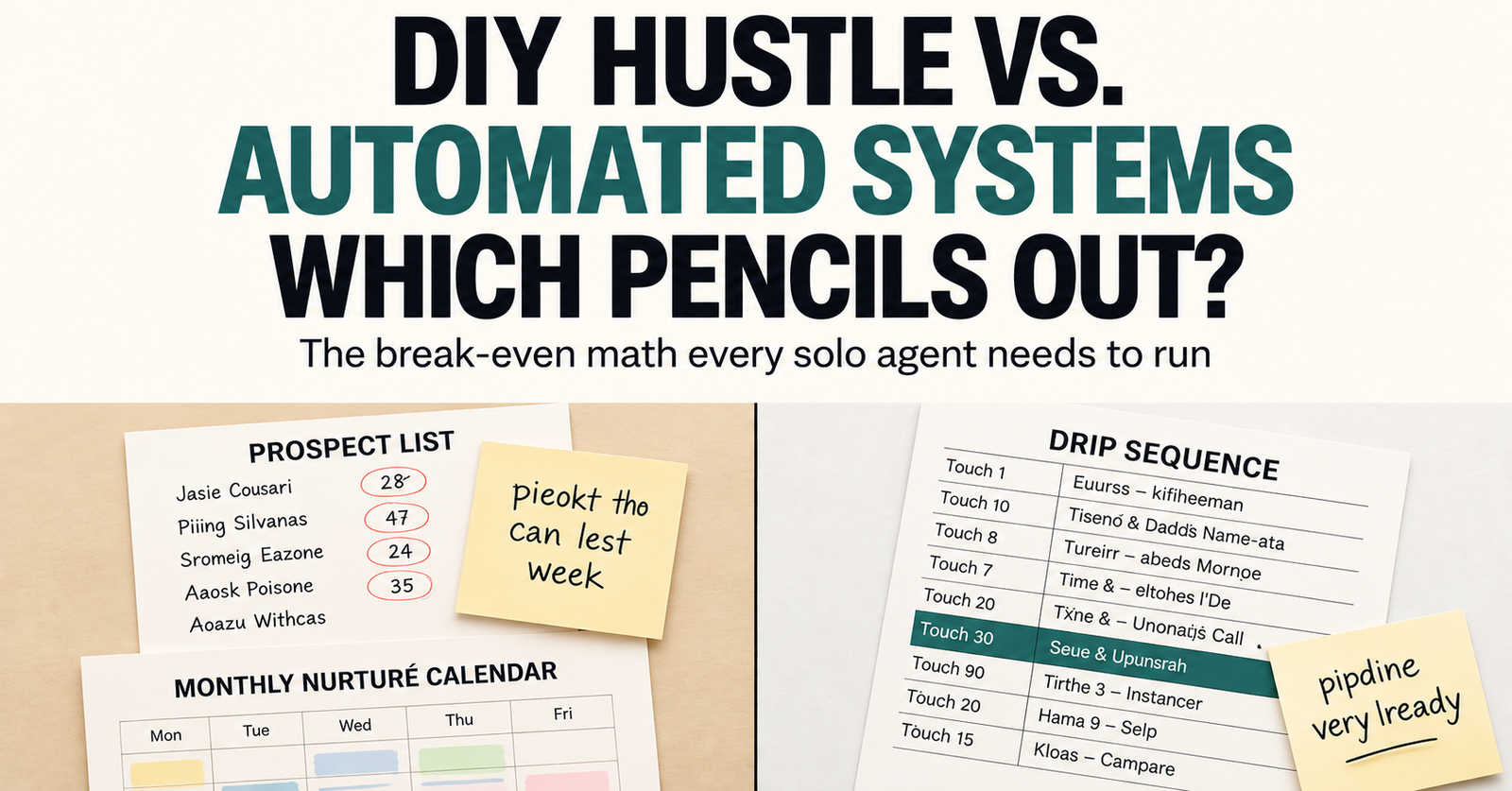
Here is the real question: do you have more time or more money? That one answer decides almost everything about which real estate lead generating approach will work for you. Ignore it and you will spend money optimizing the wrong thing.
Every agent doing their own prospecting is running a trade — time for pipeline. Every agent paying for automation is running a different trade — money for consistency.
Neither is automatically smarter. Both have a break-even point.
The Case for DIY Hustle
DIY wins on cash outlay. Sphere of influence, database reactivation, referral systems, open houses, organic social, Google Business Profile — none of these require a monthly platform fee. The cost is your hours.
That matters most when you are early-stage or budget-constrained. Re-engaging a database of past clients and warm contacts costs roughly two to three dollars per lead.
Paid search lead costs run around $480 per lead on some platforms. The math on owned-audience methods is hard to argue with, as long as you actually work them.
The deeper advantage is control. You own the audience. You set the message.
You are not dependent on a lead vendor’s pricing changes or a platform’s algorithm deciding your ads are no longer worth running. That independence has real value as your business grows.
The problem is consistency. DIY only works if you keep up with fast follow-up, repeated touches, and a pipeline that you tend to every week without fail. Most solo agents cannot do that and also handle transactions, client calls, and showings.
The prospecting slips. The leads go cold. The pipeline drains.
The Case for Automated Systems
Automation pencils out when your time costs more than the software does. The value proposition is simple: capture leads instantly, trigger immediate responses, run nurture sequences without manual effort, and never drop an inquiry because you were in a showing.
Speed-to-lead is not a minor detail. Contacting a new lead within minutes rather than hours meaningfully improves the odds they pick up and engage.
Automation enforces that standard. It routes new inquiries into a CRM, fires an immediate text or email, and keeps the prospect in a sequence until they raise their hand.
The tradeoff is real. Software fees, setup work, and a learning curve are all costs that DIY does not carry. Some platforms bundle lead generation, IDX, CRM, and follow-up in one system.
Others require you to connect separate tools, which means integration work and more things that can break. If you are not tracking cost per lead and cost per closing, automation can feel productive while quietly becoming expensive.
The agents who get burned by automation are usually the ones who treat it as a replacement for a sales process rather than a tool that enforces one. Automated follow-up on a lead that no one ever actually calls is just scheduled noise.
Where the Cost Gap Is Largest
The single biggest cost difference between DIY and automation shows up in long-cycle leads — the buyer who is six to eighteen months out from a purchase decision. DIY agents almost never nurture these contacts long enough.
The manual effort required to send relevant touches every three to four weeks across a pipeline of fifty or a hundred long-cycle leads is more than most solo operators will sustain.
Automated nurture sequences handle that job at near-zero marginal cost per touch. A lead that entered your pipeline eight months ago and got consistent, relevant follow-up is far more likely to call you when they are ready than one who got two emails and silence.
That gap in conversion — not cost per lead, but conversion of leads already in the pipeline — is where automation tends to recoup its monthly fee fastest.
What the Numbers Actually Show
Four numbers decide whether your approach pencils out. Cost per lead tells you what you are spending to get each inquiry. Contact speed tells you how fast you respond once a lead comes in.
Cost per closing is the real metric — lead volume is vanity. Follow-up consistency tells you whether every lead gets nurtured long enough to convert, or whether most of them quietly expire in your inbox.
DIY that saves money on paper but delivers slow response times and inconsistent follow-up will lose to automation in practice. Automation that generates volume but never feeds a real qualification and closing process will lose to disciplined DIY at a lower total cost. The numbers only favor one approach when the full chain works.
The Hybrid That Actually Pencils Out
The strongest economics usually come from DIY acquisition combined with automated follow-up. These two things do different jobs.
DIY sources — referrals, sphere outreach, organic content, open houses — build your owned pipeline cheaply. Automation prevents leakage once leads are in the system.
A solo agent or small team trying to run both manually will burn out. The prospecting is already a full job.
The follow-up is a second job. Adding consistent content, fast response, and long-cycle nurture on top of transaction management is where the wheels come off for most people.
The agents with the best unit economics are not the ones spending the most on leads or the ones doing everything by hand. They are the ones who have matched their lead source to their time budget and their follow-up system to their volume.
A Direct ROI Framework
Before you decide anything, run this check. Take your last 90 days of lead activity and answer four questions. What did each lead cost you to acquire, in dollars and hours?
How fast did you respond to new inquiries on average? What did each closed transaction actually cost you, counting all lead spend? And what percentage of leads received at least five follow-up touches before being marked dead?
If your cost per lead is low but your contact speed is slow and follow-up drops off after two touches, you have a process problem that DIY volume will not fix. If your automation costs are high but your close rate is also high, the system is working even if the monthly bill feels uncomfortable.
If your close rate is low despite high lead volume, the system is leaking somewhere — usually at contact speed or qualification.
Real estate lead generating is not a channel decision. It is an operations decision. Which channels feed your pipeline at a cost you can sustain, and which system makes sure nothing that enters the pipeline gets lost — those two questions matter more than any debate about DIY versus automation in the abstract.
The agents building durable pipelines in 2025 are not choosing between hustle and systems. They are choosing how much of each their actual business can support, then building accordingly.
| Scenario | Better Fit | Why |
|---|---|---|
| Low cash, high time | DIY hustle | Lowest direct spend; builds owned audience and database cheaply |
| Higher cash, low time | Automated system | Faster response, consistent nurture, less manual labor per lead |
| Busy solo agent or growing small team | Hybrid | DIY sources build the pipeline; automation prevents leakage and follow-up burnout |
| High lead volume, low close rate | Fix the process first | More leads into a broken qualification and follow-up chain just costs more |
Keep reading: The Real Cost of Real Estate Lead Generation Platforms vs. Automating the Role Entirely · Real Estate Lead Generation Platforms: What to Look For Before You Pay for One
Frequently Asked Questions
Is DIY real estate lead generation actually cheaper than using automated tools?
On direct cash outlay, yes — DIY methods like database reactivation, referrals, and organic content cost far less per lead than paid platforms or automation software. But the full cost includes your time. If prospecting pulls you away from transactions you could be closing, the ‘cheaper’ option may not pencil out when you count total hours.
How fast does a solo agent need to respond to a new lead for it to convert?
Responding within minutes rather than hours meaningfully improves contact and conversion odds. Most solo agents cannot hit that standard manually when they are in showings or on calls. Automated immediate response — a text or email triggered by a new inquiry — is the most direct fix for this specific problem.
What is the biggest mistake agents make with real estate lead generating automation?
Treating automation as a replacement for a sales process rather than a tool that enforces one. Automated sequences on leads that no one ever actually calls or qualifies produce activity metrics, not closings. The automation handles follow-up volume; a human still has to close.
What metrics should I track to know if my lead generation is working?
Cost per lead, contact speed, cost per closing, and follow-up consistency are the four that matter. Lead volume and open rates are secondary. A low cost per lead combined with a slow response time and dropped follow-up will underperform a higher-cost system with disciplined contact and nurture.
Can a one-person real estate operation run both DIY prospecting and automated follow-up at the same time?
Yes, and that hybrid is often the strongest setup. DIY prospecting — referrals, sphere outreach, open houses — builds your owned pipeline at low cost. Automated follow-up handles the nurture work that a solo agent cannot consistently do manually across a full pipeline. The two functions complement rather than compete.
How 1TeamLabs Can Solve It
1TeamLabs rents a Sales Automation AI Worker that handles outbound prospecting, instant lead response, and follow-up sequencing as a complete function — not a tool you configure and babysit. It runs the follow-up chain that most solo agents let slip, without adding a hire to your payroll.
See What a Sales AI Worker Does for Real Estate Pipeline
If the follow-up and outbound work is where your pipeline leaks, 1TeamLabs is worth a direct conversation. Book a call and walk through exactly how the Sales Automation AI Worker runs that function end-to-end.
Book a Demo
About the Author
Written by the 1TeamLabs team, builders of AI Workers that own entire business functions so solo operators and small teams can run sales, content, and marketing without adding headcount.
The Real Cost of Real Estate Lead Generation Platforms vs. Automating the Role Entirely
The invoice is not the cost. That is the first thing agents get wrong about real estate lead generation platforms. You pay $299 a month for the platform. Then you pay for the ad spend that feeds it. Then you pay in hours spent logging in, following up, and re-engaging leads who went quiet two…
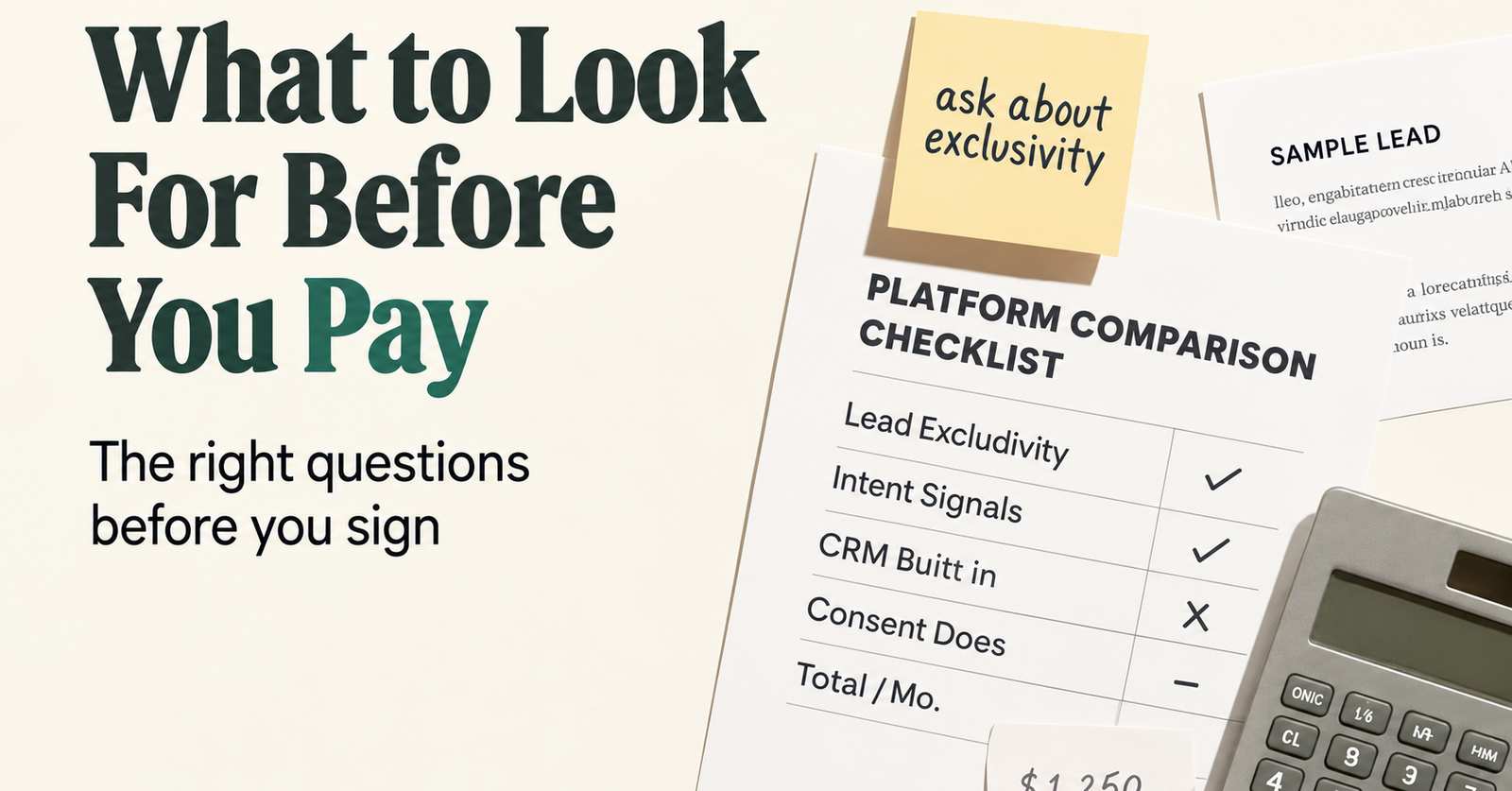
Real Estate Lead Generation Platforms: What to Look For Before You Pay for One
Most real estate lead generation platforms will promise you a pipeline. What they deliver is a list of names and a monthly charge. The gap between those two things is where most solo agents and small teams lose money. This is not a ranking of platforms. It is a set of questions to ask before…
Stop Reading. Start Shipping.
You didn't start a business to run a team. Hire your first AI Worker instead.