
How AI Sales Automation Actually Works
AI sales automation finds prospects, drafts outreach, qualifies leads, and updates your CRM — so you handle the conversations that actually close deals.
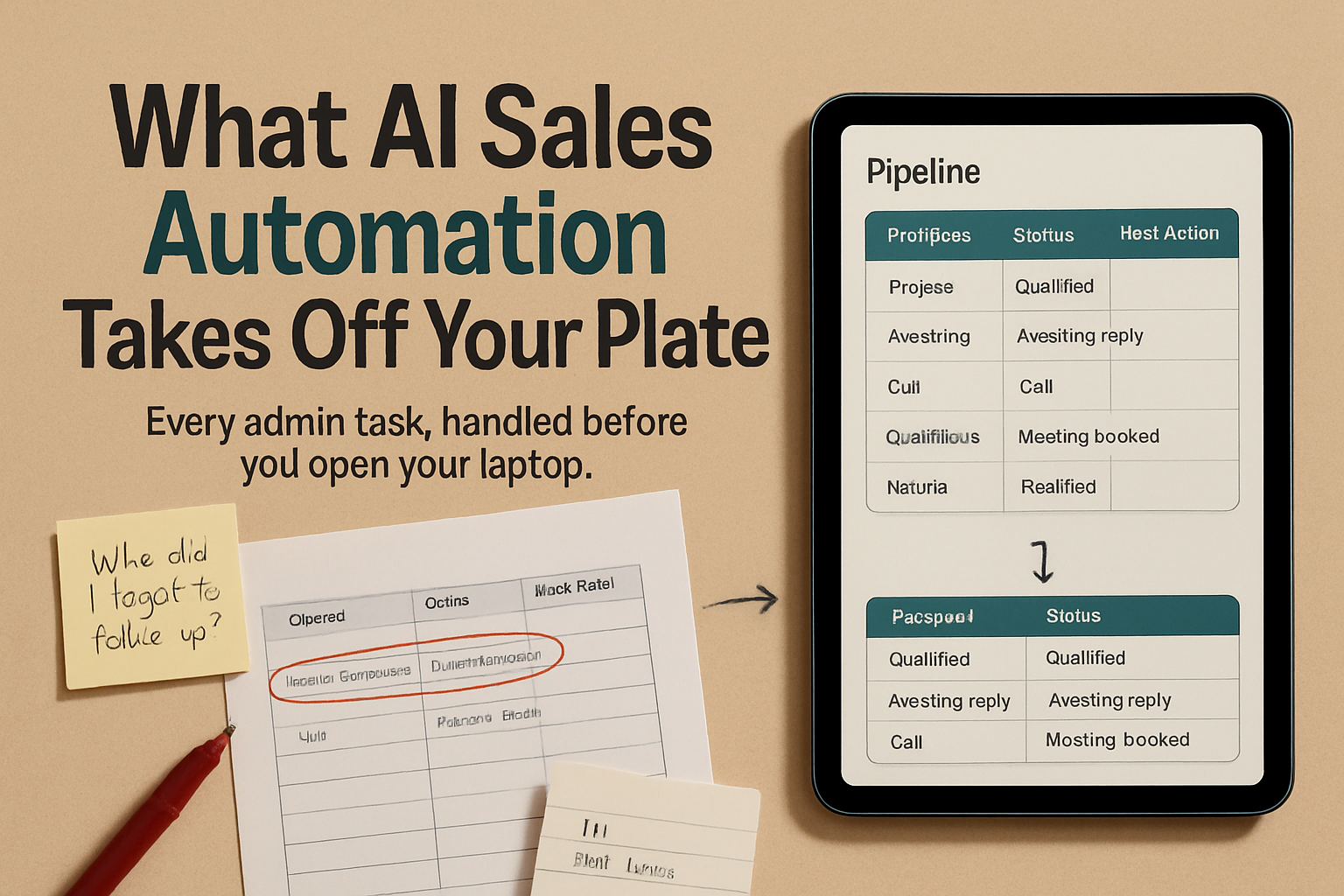
Sales teams don’t lose time because they can’t sell. They lose it to everything around selling: researching accounts, entering CRM data, writing follow-ups, scheduling meetings, and deciding which opportunities deserve attention today versus next week.
AI sales automation targets that gap. It combines rules-based workflow automation with AI models that interpret information, generate text, classify intent, and recommend the next action. The result is a sales process that moves faster while keeping a human responsible for strategy, conversation, and the final yes.
Here is what that actually looks like, step by step.
It Starts With Finding the Right People
Every system begins with an ideal customer profile: industry, company size, revenue, job title, technology used, buying triggers. AI can identify accounts and contacts that match those criteria, then watch for signals like hiring announcements, funding rounds, or technology changes that suggest someone is ready to buy.
This replaces the manual process of opening dozens of company websites, hunting for decision-makers, and copying names into a spreadsheet. The system builds the list. You decide whether the list is aimed at the right people.
One thing AI cannot fix: a poorly defined ICP. If the target market is unclear, automation helps you contact the wrong people faster.
Then It Researches Each Account
Once a prospect enters the system, AI pulls together information from your CRM, data providers, email history, and public sources. It produces a short account brief: company background, the prospect’s role and responsibilities, likely business challenges, relevant technologies, recent developments, and any prior interactions with your team.
A salesperson gets useful context without spending an hour researching every account before a call. The AI handles the compilation. The salesperson handles the judgment about what matters.
Human review still applies. AI-generated data can be outdated, incomplete, or matched to the wrong contact. Treat account briefs as a starting point, not a guarantee.
It Drafts the Outreach
Using account data and your messaging guidelines, AI drafts emails, LinkedIn messages, call scripts, and follow-ups. More capable systems tailor the message to the prospect’s role and situation rather than sending one generic template to everyone.
A finance leader focused on cost reduction gets different messaging than a sales leader focused on pipeline speed. The system connects a relevant business signal to a specific reason for reaching out, rather than just inserting a company name into a boilerplate.
AI should produce the draft. It should not automatically define your brand voice. Clear approval rules prevent generic, inaccurate, or off-brand outreach from going out under your name.
It Manages the Follow-Up Sequence
Traditional sequences run on fixed timing. AI-driven systems adjust based on behavior: replies, clicks, page visits, meeting bookings. A sequence might pause when a prospect responds, offer a meeting after positive engagement, route a pricing question to you directly, or escalate a high-intent prospect immediately instead of waiting for the next scheduled step.
What this takes off your plate is real: you stop tracking who needs a follow-up this week, stop manually checking which emails got opened, and stop deciding whether that reply warrants a response today or tomorrow. The system flags what needs human attention. You attend to those things.
Any automated sequence should include safeguards for consent, unsubscribe requests, and sending limits. Volume without quality damages your domain reputation and your brand.
It Qualifies and Routes Responses
AI can read inbound replies and classify them: interested, not interested, asking about pricing, raising an objection, wrong person, ready to book. It then scores or routes the lead accordingly.
A prospect who matches your ICP and asks about implementation gets routed to you immediately. A poor-fit contact who clicked but never replied stays in a lower-priority workflow. You stop reading every low-value reply manually and stop chasing opportunities that were never real.
Lead scoring is a prioritization tool, not a verdict. A low-scoring prospect may have a genuine need.
A highly engaged one may have no budget. Treat the score as input, not instruction.
It Keeps the CRM Updated
CRM maintenance is where AI earns its keep most visibly for small teams. Systems log activities, update fields, summarize emails, and create follow-up tasks based on conversations. After a call, AI extracts the main objectives discussed, pain points raised, objections, competitors mentioned, and any commitments made.
Conversation-intelligence tools can transcribe calls and flag risks or commitments that might otherwise get lost in the shuffle. The CRM stays current without you spending twenty minutes after every meeting on data entry.
Define which fields AI can update automatically and which require your confirmation. Pricing, legal language, and specific product commitments should always go through a human.
It Prepares You for the Conversations That Matter
Before a meeting, AI creates a briefing from CRM records, prior emails, call transcripts, and account history. After the meeting, it drafts a recap, identifies action items, and prepares follow-up communication.
The gap between conversation and next action shrinks. Instead of spending the hour after a call reconstructing what happened, you review the summary, correct anything that’s off, and move to the agreed next steps.
The salesperson remains accountable for accuracy, especially on pricing, product limitations, and anything with a legal or contractual dimension.
What AI Sales Automation Does Not Replace
AI handles the repetitive, structured, information-heavy work. It is less reliable when a situation requires trust, nuance, or accountability that only a human can credibly hold.
Defining sales strategy, building executive relationships, handling sensitive objections, negotiating commercial terms, managing a complex buying committee, and closing the deal all stay with the human. AI moves the prospect to the point where those skills matter. The human applies them.
The division is straightforward: automation handles research, drafting, sequencing, qualification, and logging. You handle the live conversation, the relationship, and the judgment calls no workflow can make for you.
What It Takes to Run This Well
Technology alone does not create a reliable automated sales process. The implementations that work start with operational basics.
Clean data matters first. AI performs on the quality of the account, contact, and pipeline information it draws from. Duplicate records and outdated contacts reduce performance across every step.
Clear approval rules matter second. Decide which actions can run automatically, which need a human review before firing, and which always require your direct involvement.
CRM activity logging can be automatic. Pricing language cannot.
Defined handoff points matter third. Every workflow should specify when a human takes over: a positive buying signal, a complex question, a pricing request, a high-value account. Without that boundary, automation either does too much or leaves prospects waiting for a response that never comes.
Finally, measure outcomes rather than activity. More automated messages do not mean better sales performance.
Track qualified meeting rate, positive reply rate, pipeline velocity, and revenue generated. Those numbers tell you whether the system is working.
| Sales Task | Without AI Automation | With AI Automation |
|---|---|---|
| Prospect research | Manual, 30-60 min per account | AI-generated brief in minutes |
| Outreach drafting | Written from scratch per segment | AI drafts, human approves |
| Follow-up scheduling | Tracked manually by rep | Triggered by prospect behavior |
| Lead qualification | Rep reads every reply | AI classifies and routes |
| CRM updates | Manual data entry after each call | Auto-logged from conversations |
| Meeting prep | Rep reviews scattered notes | AI brief from full account history |
Keep reading: AI Sales Automation vs. Hiring a Sales Rep: What It Really Costs · Best AI Sales Automation Software for Small Teams: What to Buy
Frequently Asked Questions
Does AI sales automation replace a salesperson?
No. AI handles the research, drafting, sequencing, qualification, and logging. The salesperson handles live conversations, relationship building, negotiation, and closing. The goal is to give a salesperson more time for the work AI cannot do reliably.
How personalized is AI-generated outreach?
It depends on the system and the data available. Basic systems insert a name or company into a template. More capable systems connect a specific business signal — a hiring announcement, a technology change, a company milestone — to a relevant reason for reaching out. The latter requires clean data and clear messaging guidelines from your team.
What data does AI sales automation need to work?
At minimum: a defined ideal customer profile, clean CRM records, and a set of messaging guidelines. The cleaner and more complete your account and contact data, the better the system performs at every stage from prospecting through qualification.
Which parts of the sales process should always stay with a human?
Sales strategy, executive relationship management, handling sensitive objections, negotiating commercial terms, making product commitments, and closing the deal. Any action with legal, contractual, or high-stakes relationship consequences should require human approval before it happens.
How do you measure whether AI sales automation is actually working?
Track outcomes, not activity volume. Qualified meeting rate, positive reply rate, pipeline velocity, and revenue generated tell you whether the system is producing results. More automated messages with no improvement in those numbers means the system needs adjustment, not more volume.
How 1TeamLabs Can Solve It
1TeamLabs rents a Sales Automation AI Worker that owns this entire sequence end-to-end: finding prospects, drafting personalized outreach, managing follow-ups, qualifying responses, and keeping your pipeline updated, without you hiring or managing anyone to run it.
See What an AI Sales Worker Actually Handles
If you’re running sales yourself and want to see exactly which tasks an AI Worker takes off your plate, 1TeamLabs can walk you through how it works for a team your size.
See What an AI Sales Worker Actually Handles
About the Author
Written by the 1TeamLabs team, builders of AI Workers that own entire business functions so solopreneurs and small teams can stop doing the work that surrounds selling and start doing more of the selling itself.
Frequently Asked Questions
I'm a solopreneur with a messy CRM. Can I still start with AI sales automation?
You can start, but clean data comes first. AI sales automation performs on the quality of the account, contact and pipeline information it draws from, and duplicate records or outdated contacts drag down every step. Clear out the duplicates, confirm your contacts, and write down your messaging guidelines. Then the system has something solid to work from.
What happens if my ideal customer profile isn't clearly defined?
Automation will help you contact the wrong people faster. That is the one thing AI cannot fix. The system builds the list from the criteria you give it: industry, company size, job title, technology used, buying triggers. You decide whether that list is aimed at the right people before anything goes out.
How is hiring an AI Worker different from hiring a salesperson?
Hiring means training, managing and turnover. An AI Worker is the third option between hiring someone and doing it all yourself. The 1TeamLabs Sales AI Worker owns the whole sequence end-to-end: finding prospects, drafting personalized outreach, managing follow-ups, qualifying responses and keeping your pipeline updated. You approve the work instead of managing a person.
How do I stop automated outreach from hurting my brand or domain reputation?
Set approval rules before you turn anything on. Any automated sequence should include safeguards for consent, unsubscribe requests and sending limits, because volume without quality damages both your domain reputation and your name. AI should produce the draft, not define your brand voice. Decide which actions run automatically, which need your review, and which always require you directly.
AI Sales Automation vs. Hiring a Sales Rep: What It Really Costs
AI sales automation software or a sales rep? See the real monthly and yearly costs, ramp time, hidden fees, and which one fits a solo operator or small team.
Best AI Sales Automation Software for Small Teams: What to Buy
Picking AI sales automation software for a team of one to five? Here is what the pricing pages hide, what to skip, and what to demand before you pay.
AI Sales Automation Software for Small Teams: A Founder's Shortlist
Five AI sales automation tools worth considering for small teams. Honest breakdown of what each one does well, where it falls short, and how to choose in an afternoon.
Stop Reading. Start Shipping.
You didn't start a business to run a team. Hire your first AI Worker instead.