
Best Lead Generation for Real Estate: Manual vs. Automated
You are probably spending more on lead generation than your spreadsheet shows. The line items are easy to count — ad spend, a VA, maybe a CRM subscription. What does not show up is the cost of a 14-hour response time, a nurture sequence that never gets sent, and a database of old contacts nobody…
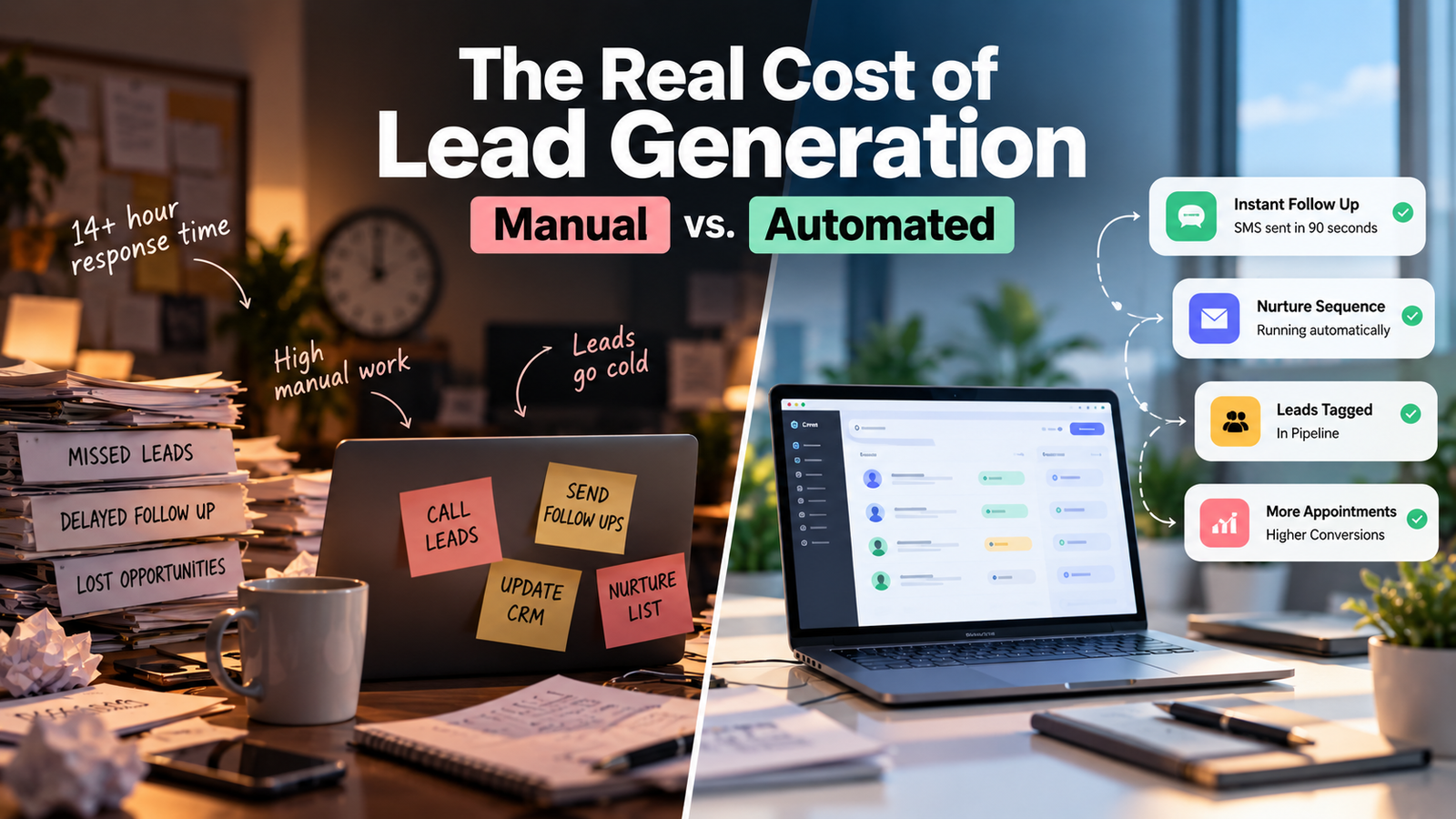
You are probably spending more on lead generation than your spreadsheet shows. The line items are easy to count — ad spend, a VA, maybe a CRM subscription.
What does not show up is the cost of a 14-hour response time, a nurture sequence that never gets sent, and a database of old contacts nobody touches.
This is the comparison most real estate guides skip. Not “should I buy leads or generate them organically,” but what it actually costs to run the whole function manually versus handing the repetitive parts to an automated system.
What Manual Lead Generation Actually Costs
A solo agent or small team running lead gen by hand looks cheap on paper. In practice, once you count labor and leakage, it runs $2,000 to $4,000 or more per month when management time, VA fees, inconsistent follow-up, and turnover are all included.
The bigger hit is not always the dollar amount. It is what happens to leads while you are busy with something else. Manual follow-up averages 14 to 18 hours between a lead coming in and a first response.
By then, the lead has heard from someone else. Speed-to-lead is one of the strongest predictors of whether an inquiry becomes an appointment, and manual systems are structurally slow at it.
One estimate puts manual admin load for a solo agent at around 25 hours per week before any automation. That is more than half a full-time job spent on tasks that are completely repeatable: tagging, reminders, sending follow-up emails, updating pipeline status. That time has an opportunity cost, and it is a large one.
What Automation Actually Costs
Automation is not free, but the operating cost is a fraction of what a manual approach runs. For a solo agent or small team, meaningful automation — CRM, email and SMS workflows, basic lead routing — runs roughly $150 to $600 per month.
That covers real infrastructure: instant follow-up sequences, long-term nurture drips, pipeline tagging, and reporting.
Compare that with $1,000 to $1,400 per month for a VA-managed approach, or $2,000 to $4,000-plus for a fully manual setup with staff. The gap is not marginal. It is large enough to matter even before you factor in conversion improvement.
There is a ceiling to this: custom enterprise AI builds can run $30,000 to $500,000 in setup costs with ongoing monthly costs in the thousands. That is a different product for a different buyer.
If you are a solo agent or a team of two to five, the $150 to $600 range is the relevant number.
The Conversion Gap Is Where the Real Money Is
Lower operating cost is the obvious win. The less obvious win is what happens to the leads you are already paying for.
A team contacting 30% of its leads manually versus 60% with automated speed-to-lead workflows is running the same ad spend and getting half the output on the conversion side. The cost per lead looks identical.
The cost per appointment is not. That gap — between lead spend and actual closings — is where manual systems quietly drain money that never shows up as a line item.
Reactivating an existing contact is five to ten times less expensive than acquiring a new lead, and those reactivations convert three to four times better than cold acquisition. Manual systems let those contacts go dormant because nobody has time to work through a list.
Automated drip sequences keep the relationship alive with no ongoing labor cost.
Companies that automate lead management have seen revenue increases of around 10% over six to nine months — not from spending more on ads, but from handling the same leads better.
A Concrete Example: The Same $1,000 in Ad Spend
Take two agents each spending $1,000 per month on paid leads. Agent A follows up manually, averaging a 15-hour response time and working through about 30% of the leads before attention drifts to active clients.
Agent B runs an automated workflow: every lead gets an SMS within 90 seconds, enters a 12-touch nurture sequence, and gets flagged for a personal call only after showing engagement.
Agent A generates roughly the same number of conversations every month but closes fewer of them because the pipeline is inconsistent. Agent B contacts twice the percentage of leads from the same spend and books more appointments without changing the ad budget.
The $1,000 is identical. The cost per closing is not even close.
This is not a hypothetical edge case. It is the direct result of response time and nurture consistency — both of which are structural advantages of automation, not talent advantages of a better agent.
Where Automation Earns Its Keep
Automation does not replace judgment. It replaces repetition. The highest-return tasks to automate are the ones that are time-sensitive, standardized, and currently falling through the cracks.
Instant SMS or email follow-up the moment a lead comes in. Long-term drip nurture for contacts who are not ready yet. Reactivation campaigns for dormant databases.
Automated CMA report generation and pipeline tagging. These are not complex decisions — they are repeatable actions that a human is handling manually right now and doing inconsistently because humans are not built for consistency at scale.
The 24/7 availability is not a feature to put in a brochure. It is a practical reality: a lead that comes in at 9pm on a Saturday gets an immediate, relevant response instead of waiting until Monday morning when the agent is already behind on three other things.
When Staying Manual Makes Sense
There are situations where automation is not the right move yet. If your lead volume is very low, the overhead of setting up and maintaining workflows may not be worth it.
If your business depends heavily on personal relationship management and your contacts expect a very high-touch, individualized experience, some of that cannot and should not be templated.
And if you have not yet defined stable, repeatable processes — if every lead is handled differently depending on who you feel like calling that day — then automating before you have clear workflows bakes chaos into your system at scale.
The practical rule: automate the parts that are already consistent enough to be templated. Follow-up timing, nurture messaging, tagging, reminders, reporting. Keep the judgment calls, negotiations, and relationship moments human.
The Comparison in Plain Numbers
Manual lead generation, fully loaded with labor and management: $2,000 to $4,000-plus per month, with 25 hours per week of admin, hours-long response times, and conversion that leaks at every slow handoff.
Automated lead generation infrastructure for a solo agent or small team: $150 to $600 per month, with instant response, consistent nurture, and conversion that improves because fewer leads get dropped or go cold.
The cost of automation is not the barrier. The barrier is usually that no one has set it up and nobody has time to do it while also running the business.
| Factor | Manual Process | Automated Process |
|---|---|---|
| Monthly operating cost | $2,000–$4,000+ with labor included | $150–$600 for solo/small-team systems |
| Lead response time | Often 14–18 hours or more | Instant via SMS/email/voice workflows |
| Weekly admin time | ~25 hours/week (solo agent estimate) | Much lower once workflows are set |
| Consistency | Depends on human follow-through | Rules-based, repeatable, 24/7 |
| Lead conversion efficiency | Lower when response is slow | Higher with faster speed-to-lead |
| Scale | Adds headcount as volume rises | Scales with workflow design |
Keep reading: Best Lead Generation for Realtors: Stop Overpaying · Best Lead Generation for Real Estate: What Works vs. Hype
Frequently Asked Questions
What is the best lead generation approach for a solo real estate agent?
For most solo agents, the highest-return approach is combining a stable lead source (ads, referrals, or sphere outreach) with automated follow-up and nurture workflows. The lead source matters less than what happens after the lead arrives. Instant response and consistent nurture convert more of the same lead volume without adding headcount or ad spend.
How much does it cost to automate real estate lead generation?
For a solo agent or small team, meaningful automation infrastructure — CRM, email and SMS sequences, lead routing, and pipeline management — typically runs $150 to $600 per month. That is significantly less than a VA-managed approach ($1,000 to $1,400 per month) or a fully manual operation with staff ($2,000 to $4,000-plus per month).
Why does response time matter so much in real estate lead generation?
Speed-to-lead is one of the strongest predictors of whether an inquiry becomes an appointment. Manual systems average 14 to 18 hours between lead arrival and first contact. By then, many leads have already spoken to a competitor. Automated workflows respond instantly, regardless of the time of day or how busy the agent is.
Is it worth reactivating old real estate leads instead of buying new ones?
Yes. Reactivating an existing contact costs five to ten times less than acquiring a new lead, and those contacts convert three to four times better than cold acquisition. Most solo agents and small teams have dormant databases they are not working because they lack the time. Automated drip sequences handle that at near-zero ongoing cost.
When does it make sense to keep real estate lead generation manual?
Manual processes still make sense when lead volume is very low, when the business relies on highly personalized relationship management that cannot be templated, or when workflows are not yet stable enough to automate reliably. Even then, automating the repeatable parts first — follow-up timing, nurture sequences, tagging — typically delivers the fastest return.
How 1TeamLabs Can Solve It
1TeamLabs rents a Sales Automation AI Worker that owns the lead generation function end-to-end: outbound outreach, instant follow-up, and pipeline nurture running without a human in the loop at every step. It is the automated infrastructure described in this article, without the setup overhead of building it yourself.
See What an AI Worker Costs vs. What You Are Spending Now
If the numbers in this article look familiar, 1TeamLabs can walk you through what a Sales Automation AI Worker would actually run for your operation. No agency pitch — just a direct comparison against what you are doing today.
Book a Demo
About the Author
Written by the 1TeamLabs team, builders of AI Workers that own entire business functions — sales, content, video ads, and AI search visibility — for solopreneurs and small teams.
The Real Cost of Real Estate Lead Generation Platforms vs. Automating the Role Entirely
The invoice is not the cost. That is the first thing agents get wrong about real estate lead generation platforms. You pay $299 a month for the platform. Then you pay for the ad spend that feeds it. Then you pay in hours spent logging in, following up, and re-engaging leads who went quiet two…

Best Lead Generation for Realtors: Stop Overpaying
Two agents. Same zip code. Same lead source. One closes deals. One bleeds money. The difference is almost never the leads themselves. Most realtors treat lead generation as a volume problem. Buy more leads, close more deals. That logic sounds reasonable until you’re spending $1,500 a month on Zillow and booking two appointments that both…
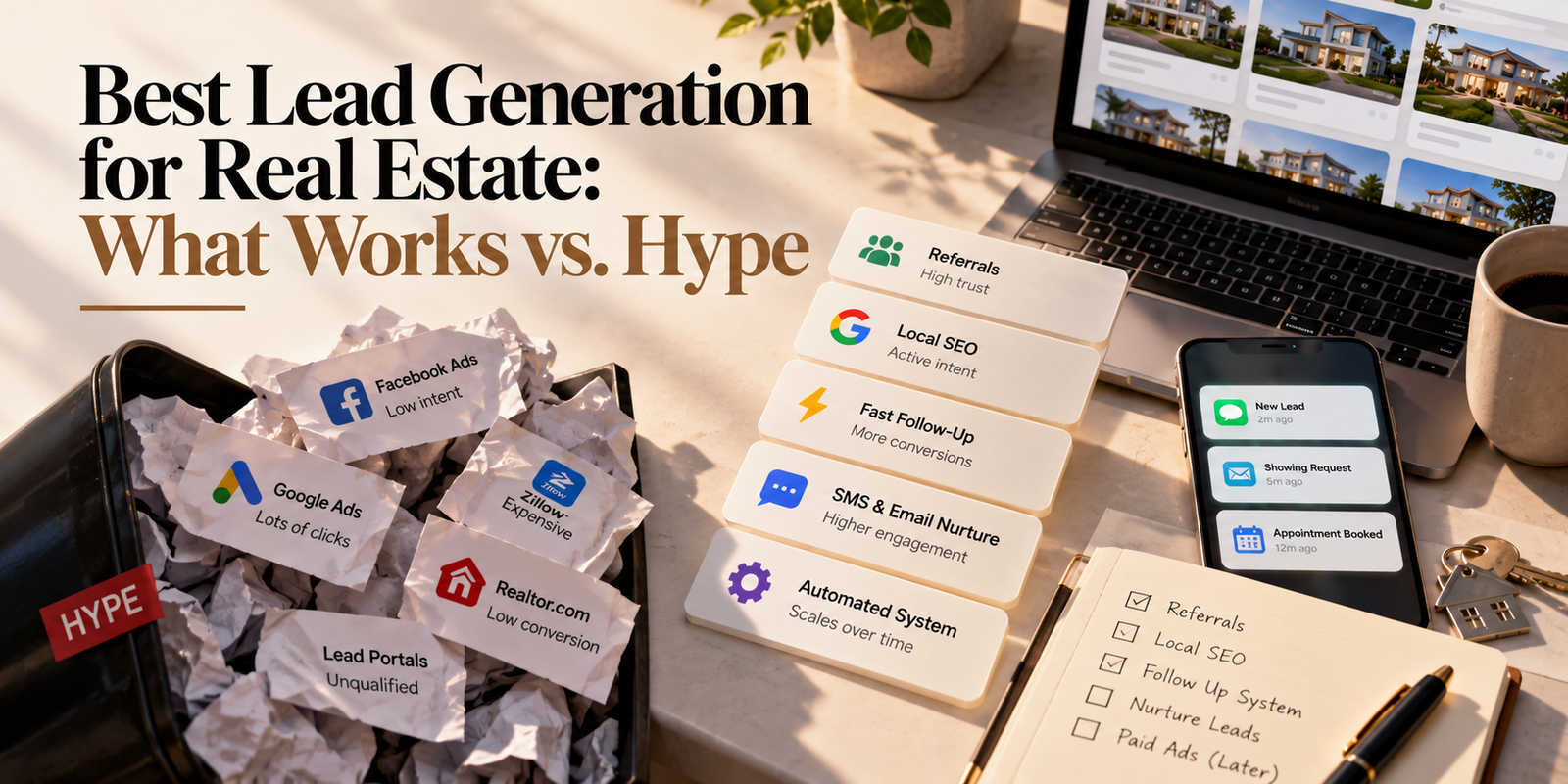
Best Lead Generation for Real Estate: What Works vs. Hype
A lot of real estate lead generation advice sounds impressive until you ask one question: does it produce people who actually want to buy or sell, and can you convert them at a margin that makes sense? The answer, for most of what agencies sell, is no. The gap between what works and what gets…
Stop Reading. Start Shipping.
You didn't start a business to run a team. Hire your first AI Worker instead.